By: Clyde Ramalaine
– Is she merely narrating as before from Stellenbosch scripts, it’s not her original thoughts just as state capture in 2016 was not.
As the State of Capture’s time is running swiftly to end jolts of inflections or is it deflections threaten detailing its dying days. The commission often dubbed the Zondo Commission an accepted practice that takes identity in who leads the commission is unfortunately also deceptively identified as the State Capture Commission. This often overlooks mispronunciation of the commission is not just deliberate but also political. The commission was brought into existence to investigate the plausibility of a captured state. Now depending on where you find yourself in the polarized SA world of views, some will tell you DCJ Zondo’s Commission had proven the presence of state capture while others of whom I am one would advocate state capture cannot be proven in the commission because it was, is and remains a political campaign.
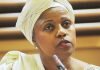
I have said the commission will find corruption but the unique media invented crime of state capture will remain a mirage. In recent days some of the deflections that entered our discourse are led by none other than the original source for this commission, former public protector Thuli Madonsela who now four years later finds herself in academic gowns of a Stellenbosch academic institution with a title of professor. Madonsela the colourful jagged-edged public protector who in her own way revolutionized this Chapter 9 institution before her departure in October 2016 did more than legal work while leading this institution.
I am on record to have said Madonsela politicized this office until her successor is embroiled in what is defined for some political wrangles with the incumbent president and arguably his chief lieutenant in a relationship where we not always sure who leads. Madonsela’s two predecessors were ordinary officials if we look her meteoritic rise to power from the bedrock of that office Madonsela have shown she has a vested interest in both the PP office post her departure with her sponsored lectures and opinions on the commission. In typical Helen Zille style of not seeking to cut the umbilical cord between herself and the report that produced this commission she has eked out a continuity of existence measurable in State Capture her report and the office she never really at a personal level left. It is as if she broods over it as her offspring. While most reports of this nature belong to the institutions it was generated in, Madonsela outside the office holds held onto it with a pungent need to want to be public on such. We thus must assume for either her own combination of political or economic reasons.
Madonsela in this epoch now is coughing muttered inflexions of amnesty for those standing accused of corruption. Let us hear Madonsela in her own words:
“The suggestion that we should have an amnesty-like process is to fish out people who can give us more information about the extent of corruption.” “How it happened, who was involved, what in the system enabled it, and where is the money? The idea is to get those that were minor actors, who wouldn’t be the kingpins or the main beneficiaries. It would be something like an admin clerk in the system who, out of fear of losing their jobs, participated in the crime,”
From this advanced rationale former Public Protector now Professor Thuli Madonsela in 2020 believes the key to rooting out corruption in SA might be through a Truth and Reconciliation Commission where those involved in the scourge of corruption however defined, would confess their unscrupulous behaviour without fear of being prosecuted.
Listening to Madonsela’s newer thoughts on how truth on corruption could be unearthed with the intend of what she calls a rooting out of corruption presents a set of dialectical if not conflicting notions.
In the first instance, why was Madonsela as Public Protector at the time not alive to this apparent wisdom she now in professorial designation seeks to suggest? Are we hearing her advocating for another commission? Is this then her analysis of the current commission as having dismally failed that another process immanent in a commission is needed? If we accept the subject of rooting out of corruption was always the cardinal focus, why not have proposed this initially. She was brave enough to direct that the then-president be not allowed to decide on who of the judiciary must lead the commission. We must then assume it was within her ambit to have made such a proposal, it is materially not important to argue what the outcomes may or may have been for her preferred proposal. It thus means there is justifiable cause for concern as to what really informed Madonsela’s original disposition as evidenced in her questionable and hastily compiled report as she was about to empty her desk.
On another score, Madonsela will forgive us to hear her subtle but implicit admission that her report may not have been morally inspired but may in all probability have derived a political frame. Shall we afford Madonsela the benefit of maturity that has set in over the last four years? Or shall we with the benefit of maintaining a critical distance of reflection advance the idea of that original choice informed by politics to have this commission no different to her newfound morality thrust that evidence a transactional amnesty for those who will be willing to share information to nail the bigger fish and therefore retrieving stolen money may have the same womb? We dare not be oblivious to Madonsela’s stances then and now, these warrant contextualization and critical engagement I will dare to advance the choices to have the commission and the new notion of a TRC frame are both mutually inclusive as not originating from Madonsela but may well detail the political agenda behind Madonsela’s suspicious actions.
The third challenge with Madonsela’s newfound morality argument is the aims of such a process. Reading her rationale carefully one sees she does not believe this commission had yet unearthed the truth of its original intention. Meaning for those who share Thuli’s mind the truth is still out there after two 26 months of hearings at a bloated budget that bulged into a billion with a most recent further R63million injection, the state capture script narrator today tells us we should follow another process to unearth the same truth [ this current commission after 26 months], to entice smaller fries in the objective of really catching the proverbial big fish in hope of retrieving the billions. I don’t think listeners hear Madonsela – this is arguably the biggest concession on the script narrator that the State Capture project draped in a Commission has failed in its original intention. You may then ask what the original intention was: That was to prove Jacob G Zuma as not just the prime suspect but the guilty one.
Professor Thuli Madonsela or is it the non-departing Public protector on October 19, 2020, still looks for the bigger fish which begs the question what bigger fish will her advanced TRC process unearth bigger than a former SA president Jacob Zuma and the family South Africa is scripted to hate, the Guptas? Madonsela does not tell us what would inform a small fry in degrees of millions from a big fish that the first-mentioned warrant an amnesty?
Maybe the critical flaw of this Commission was that it never called this former pubic protector to engage her on her report. If the challenge was to ascertain the state of capture than the framing of state capture as designed in her report [the one that shot her into stardom and a professor designation at the heart of apartheid’s academic womb]. One would have thought it is ample if not adequate need to have ascertained by calling her as a witness to answer on her methodology, approach and praxis for arriving at her report the same which details the reason for this commission.
Equally so what if witnesses such as former Eskom CEO Brian Molefe who is public that he submitted 103 documents that Madonsela wilfully disregarded wanted to cross-examine her. Had this commission been sincere to ascertain the state of capture it could only have been in its interest to locate the former public protector at the interstice of a pre-and-post state capture paradigm that defines SA in democracy. It then appears the Commission as its stands accused by Lucky Montana for having taken the account of Popo Molefe as gospel did the same with the Madonsela PP report. Herein lies a fundamental problem that perpetually begins to cast long shadows over the intention, the function of the Zondo commission.
Perhaps a bigger truth is overlooked in this Madonsela deflections that being is it possible that the Stellenbosch agenda has been served and the material tainted state of Jacob Zuma and the ANC directly is immortalized while their regain of directing the SA economic and social life spaces, lost under Zuma is with the Urban Foundation and White Monopoly Capital sponsored Ramaphosa a thing of the past. Meaning the BRICS choices that Zuma consciously and brazenly led in defiance of the old West order, systems and its institutions such as IMF and World Bank are now back in pound seats driving the future narrative of SA.
Is there a place you reach when you know you may have overplayed your hand and if you go one step further what you had hoped would nail your opponent really comes at you with more than snarls but real threats? I say that to hypothetically argue Stellenbosch knows that Zuma is in a corner and that he has access to information which can be verified. Are they with this Madonsela new wisdom really admitting it’s of no interest to continue pursuing Zuma because he may really come and expose whom Stellenbosch and its colonial partners in crime protect in ANC spaces not from today but from whenever?
In that sense, Madonsela’s new so-called superior wisdom is firstly not hers just as her decision for the lynching of Zuma in political campaign draped in judiciary uniform was not hers but that of those who rewarded her more than handsomely with a chair at Stellenbosch. Shall we know how much she earns in this position and what that means for the rectors’ income?
Stellenbosch is not stupid they know the evidence before the commission will never conform a state capture finding against Zuma, they know that hitherto nothing directly links Zuma. They knew from the start but needed to press ahead because his tainted state may prevent him from making a second run for power. We all know there is nothing in the current ANC constitution that prevents Zuma with his authentic constituency of ANC followers to run for a third term and to complete his incomplete State President term after which he may decide who should take over from him. Stellenbosch knew how important it was to have Zuma the only real politician in the ANC with a true following tainted in state capture, the fulcrum of the DA 2009 political campaign. If you ask me Zuma would be ill-advised not to rethink entering the race and make that constituency and following count.
As for Thuli Madonsela, she is merely a pawn in the bigger scheme of Stellenbosch thinking and infrastructure. She may have articulated this notion of amnesty for corruption but she is not the original source but then narrator as she narrated DA capture political campaigns and became a willing partner to give that political campaign the support of a Chapter 9 institution.
I still hold Madonsela owes to explain herself on her choices in her report and for then R1bn South Africa continues to waste on Zondo Commission.